Install Google Earth Behind Proxy Average ratng: 5,0/5 9426 reviews
Minimum:. Operating System: Fedora 20 or later or Ubuntu 12.04 (or equivalent). Linux Standard Base (LSB): 4.0. CPU: i686 or amd64 compatible, 1GHz.
System Memory (RAM): 2GB. Hard Disk: 2GB free space. Internet Connection. 3D Graphics Subsystem: OpenGL 1.4 compatible Recommended:. CPU: amd64 compatible, 2GHz. System Memory (RAM): 4GB.
Google Updater, the New Installer for Google Software. If I want to install Google Earth. Google Operating System Blog is not affiliated with Google™. Experts Exchange > Questions > Run Chrome from behind Squid Proxy. So download from here the. Google accounts / google earth etc from behind the proxy.
Hard Disk: 4GB free space. High-Speed Internet Connection.
Install Google Earth Behind Proxy On Mac
3D Graphics Subsystem: OpenGL 2.0 compatible. Screen: 1280x1024, 32 bit color Google Earth Pro functions with most recent versions of the Ubuntu and Fedora Linux distributions. Google Earth Pro may run on other popular distributions as well, but due to the wide variety of Linux platforms available, this is not guaranteed. Install Google Earth Pro.
Install Google Earth Free Download

Open 'GoogleEarthProMac-Intel.dmg'. Open the 'Install Google Earth Pro.pkg' file and follow the installation process.
To open Google Earth Pro, open your Applications folder and double-click Google Earth Pro. Note: During the installation process, Mac OS X will ask for an administrator password.
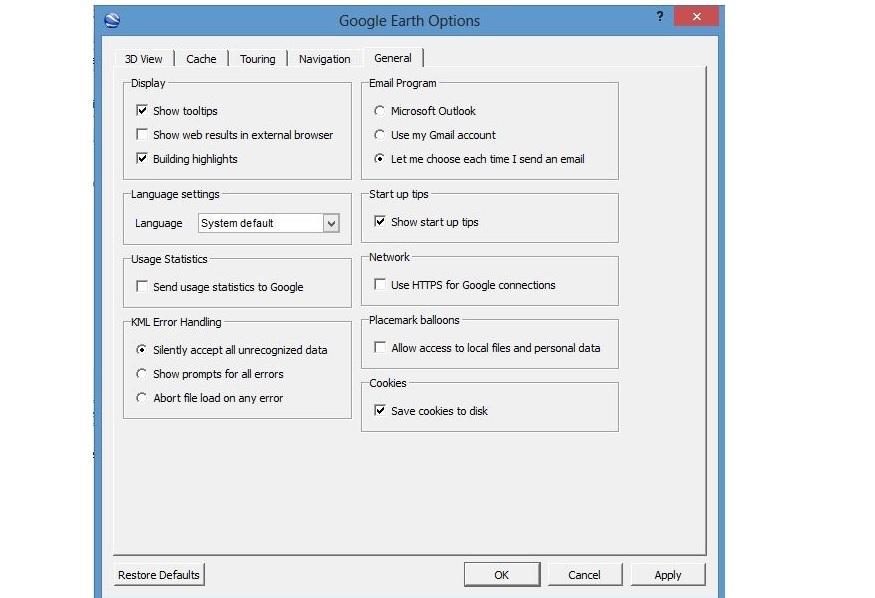
This information is never shared with Google. Fix installation errors Before attempting any of the instructions below:. If you're using Google Earth Pro, verify that you have administrative rights on your machine or install through an administrator account on the local machine.
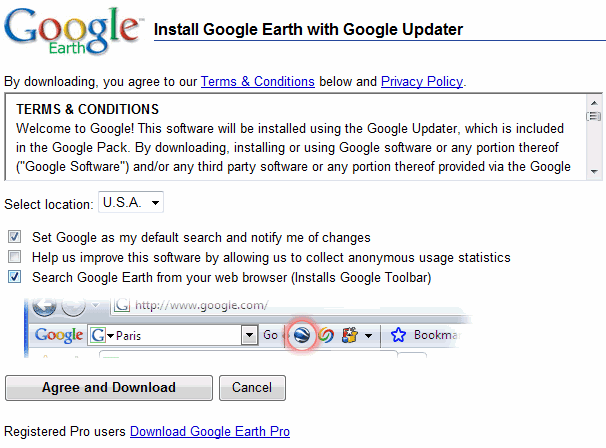
If you're having trouble connecting to Google Earth Pro and your machine has a software firewall, Google Earth Pro might not be able to access the internet. Examples of common anti-virus software firewalls include:. McAfee Personal Firewall Plus (also in McAfee Internet Security Suite). ZoneAlarm.
Norton Personal Firewall To help fix firewall issues in your anti-virus software preferences, verify:. googleearth.exe is not blocked (Windows only). Access to 'port 80' is available for non-browser applications Note: Before Google Earth Pro software is installed, Mac OS X will ask that you input an administrator password.
This information is never shared with Google. Uninstall Google Earth Pro. Go to your Applications folder and search for 'Google Earth Pro'. Right-click the Google Earth Pro icon and select Move to Trash. Additionally, if you'd like to remove all of the Google Earth Pro files from your Mac, follow these steps:. Go to Finder.
At the top, click Go. On your keyboard, hold Alt and click Library. Go to Caches Google Earth Pro and delete all files. Then, go to Library Application Support Google Earth Pro and delete all files. On older versions of Mac OSX:.
Go to Finder. Open the Home Directory icon labeled with your user ID.
Go to Library Caches Google Earth Pro and delete all files. Then, go to Library Application Support Google Earth Pro and delete all files.
Doesnt seem to be wrong in your step as depicted in hope it is not the user agent change, may want to see this may want to see BC access log to say the access is alright to bypass first.if it does allows, google stated some possible scenario such as due to invalid signature or time usage: hopefully not the SSL redirect stuff Google suggested other means to install or even posting to their forum Also try to specifically set the proxy in IE, even though proxy is a transparent proxy. Google Earth pulls it's proxy information from the IE settings. Ok so I fixed it. But it doesn't make any sense. So this is what I've done Combined object GoogleEarthUrls: url.domain='maps.google.co m' url.domain='geoauth.google.com' url.domain='auth.keyhole.c om' url.domain='earth.google.c om' url.domain='geo.keyhole.co m' url.domain='kh.google.com' url.domain='tools.google.c om' 1st Layer (Web auth layer) src - dst - action any - any - (IWA authectication) 2nd layer (web access layer) Layer gaurd Src - dst - service - time AD group - any - any - any Rule src - dst - service - time 1.
Any - catogory (software download) - any - any 2. Any - GoogleEarthURLs - any - any And this is working now. It installs and runs just fine. I'm not sure why though, maybe I tried to make it too complex.
But I would like to thank you for your ideas and assistance, I most certainly got some useful tips for future use. Actually being specific is what whitelisting is about and is not a bad strategy. The tedious part is knowing and identifying what is supposed to be good hence the traffic capture and that is why wildcard is not really great (but a lazy or quick way for some soln). Just to share BC kb on filtering twitter which also go specific viewing but block tweets @ Another is on Youtube which added to allow specific video and even embedded video from different domain (within itself by adding substring) @ lastly, i thought you may be interested in the best practice for the BC policy construct, optimisation, and integrity (typical vs preferred policy implementations) @ e.g. For optimisation. If your policy contains layers with hundreds or even thousands of rules, you can optimize policy evaluation by placing rules with like conditions together. Even though the number of rules is the same, the compiler is able to apply optimizations to the policy.
Note that this can be done only if the ordering of the rules within the layer does not change the intended behavior of the layer. Depending on your default policy and whether you have implemented content filtering, administrators often create blacklists or whitelists of domains or URLs. Instead of listing these as individual policy rules, the define category definition should be used. Using the define category definition will result in more optimized policy, and often, policy that can be better managed. If multiple domain or URL rules are being evaluated and the same action is being triggered for each match, use of the define category definition is preferred.
